
Penblwydd 110th Anniversary
Cwmdu Eisteddfod Cwmdu
CWMDU VILLAGE HALL – NEUADD Y PENTREF
Saturday 21st November – Sadwrn 21af Tachwedd 2026
Croeso - Welcome
Croeso i wefan Eisteddfod Cwmdu.
I ddathlu ein hirhoedledd, i dalu teyrnged i’r pwyllgorau trefnu a fu, pob cyfeilydd, pob dyfarnwr, pob llywydd ac is-lywyddion fry, ein holl gystadleuwyr – pob un gwerth y byd (a’u rhieni) a’r cynulleidfaoedd, dros y 109 Eisteddfod ddiwethaf, rydym yn cyhoeddi gwefan am y tro cyntaf yn 2026!
Diolch o galon!
Wir bwrpas y wefan, wrth gwrs yw tynnu eich sylw chi – ac i’ch denu, yn gystadleuwyr a chefnogwyr i ymuno a ni, a chodi to Neuadd Pentref Cwmdu unwaith eto, fel rhan o Eisteddfod Cwmdu rhif 110
21af Tachwedd, 2026
Croeso – Welcome to the website of the Cwmdu Eisteddfod.
To celebrate our longevity, pay tribute to all the organising committees, every accompanist, every adjudicator, every president and vice-president, all the wonderful competitors (and their parents) that have ever supported this special village tradition over it’s 109 events to date, we are launching this website in 2026!
Diolch bawb – thank you all!
But of course, the real purpose of this website is to attract your attention – competitors and supporters – to join us, in once again raising the roof (through music and culture, naturally) of the Cwmdu Village Hall at the 110th Cwmdu Eisteddfod
November 21st, 2026
Rhaglen o Ddigwyddiadau a Chystadlaethau yn Eisteddfod Cwmdu - Programme of Events at Cwmdu Eisteddfod
| Title | Age group | Notes | First prize | Second prize |
|---|---|---|---|---|
| Recitation | Under 8 | English or Welsh | Medal + £8 | £4 |
| Solo | Under 8 | Own selection | Medal + £8 | £4 |
| Instrumental/Piano | Under 8 | Own selection | Medal + £8 | £4 |
| Recitation | 8–11 | English or Welsh | Medal + £10 | £6 |
| Solo | 8–11 | Own selection | Medal + £10 | £6 |
| Instrumental Solo | 8–11 | Own selection. One instrument per competitor. | Medal + £10 | £6 |
| Pianoforte Solo | 8–11 | Own selection | Medal + £10 | £6 |
| Recitation | 12–14 | English or Welsh | Medal + £30 | £20 |
| Solo | 12–14 | Own selection | Medal + £30 | £20 |
| Instrumental Solo other than piano | 12–14 | Own selection. One instrument per competitor. | Cup + £30 | £20 |
| Pianoforte Solo | 12–14 | Own selection | Medal + £30 | £20 |
| Story | Under 8 | “My Favourite Cartoon” | Medal + £20 | £10 |
| Poem | Under 8 | “The Litter Bug” | Medal + £20 | £10 |
| Handwriting | 11 & under | This poem | Medal + £10 | £5 |
| Story | 8–11 | “Half Term Fun” | Medal + £20 | £10 |
| Poem | 8–11 | “Football Crazy”. Perpetual Plaque. | £20 | £10 |
| Instrumental Group | 11 & under | Own selection | £30 | £15 |
| Unison Singing | Under 15 | Own selection | £30 | £20 |
| Vocal Duet (Harmony) | 18 & under | Own selection | £40 | £30 |
| Instrumental Group | 12–18 | Own selection | £50 | £25 |
| Compose and present an Oration | 12–18 | Own subject choice. Maximum 3 minutes. | Cup + £30 | £20 |
| Pianoforte Solo | 18 & under | Own selection. Betty Greet Challenge Shield. | Cup + £30 | £20 |
| Solo | 15–18 | Own selection | Medal + £30 | £20 |
| Story | 12–18 | “My Treasure” | Medal + £30 | £20 |
| Poem | 12–18 | “Morning” | Medal + £30 | £20 |
| Instrumental Solo other than piano | 15–18 | Own selection. One instrument per competitor. | Cup + £30 | £20 |
| Youth Choir | 18 & under | Own selection | Cup + £60 | £30 |
| Visual Art — “Sunset” | 8–11 | Any medium, A4, no photographs | £20 | £10 |
| Visual Art — “Sunset” | 12–18 | Any medium, A4, no photographs | £30 | £15 |
| Title | Age group | Notes | First prize | Second prize |
|---|---|---|---|---|
| Song from a Musical | Own selection | £40 | £20 | |
| Recitation | Under 25 | Own selection | £40 | £20 |
| Hymn Tune | Over 60 | Own selection. 3rd prize £10. | £40 | £20 |
| Hymn Tune | Under 60 | Own selection. 3rd prize £10. | £40 | £20 |
| Best Sentence | From the word “Landscapes” | £10 | £5 | |
| Limerick | 1st line: “My wish was to win the top prize” | £10 | £5 | |
| Instrumental Solo | Own selection | £40 | £20 | |
| Folk Solo or Group | Own selection | £40 | £20 | |
| Female Solo | Own selection | £50 | £25 | |
| Humorous Poem | “The Fashion Show” | £20 | £10 | |
| Instrumental Group | Own selection | £40 | £20 | |
| Male Solo | Own selection. Perpetual Cup in memory of Mr Joe Davies. | £50 | £25 | |
| Champion Recitation | Own selection. Maximum 10 minutes. Perpetual Cup. 3rd prize £45, 4th prize £20. | £120 | £75 | |
| Duet | Own selection | £60 | £30 | |
| Poem | “Dark Skies” / “Nosweithiau Tywyll”. Perpetual Chair. | £60 | £30 | |
| Essay on a Welsh literary/historical/music topic | Own selection. Original work, maximum 1,000 words. | £60 | £30 | |
| Party, not more than 16 voices | Own selection | £75 | £40 | |
| Holiday Postcard | 8 words beginning with the letter “J” | £10 | £5 | |
| Choir — Mixed, Male or Female | Own selection. Approximate start time 9:00 pm. | Cup + £200 | £100 | |
| Short Story | “The Runner”, 750–1,000 words | £45 | £20 | |
| Champion Solo | Own selection. Challenge Cup donated by Mrs MHP Thomas JP. 3rd prize £50, 4th prize £30. | £150 | £100 | |
| Hand Made Prize Bag | Hand made. To be in the Hall by 3:00 pm. | £10 | £5 |
Submit Your Entry for the Cwmdu Eisteddfod
Join us in celebrating Welsh culture by submitting your entry for the Cwmdu Eisteddfod. Whether you’re a poet, musician, or artist, we welcome your participation. Showcase your talents and be part of our vibrant community event.
You can enter for a competition in one of three ways:
- Literary entries must be submitted by the 16th November 2026 to gaenormai@icloud.com.
Artwork and performers can enter on the day or you can: - Use the form below. You can upload copies of artwork etc
- Email us at entries@cwmdueisteddfod.org
Amodau / Conditions
- All literary entries should be original and not previously entered.
- Successful competitors not in attendance will have an admission fee deducted.
- The Committee reserves the right to appoint another adjudicator should the occasion arise.
- All literary items should reach the literature adjudicator by November 16th.
- Afternoon Literary items can be in English or Welsh.
- Competitors in Own Selection items in music should send a copy to the accompanist at least a week beforehand and provide a copy to the adjudicator at time of competition.
- All “solo” items are vocal unless otherwise stated.
- No competitor to sing, recite or play the same piece more than once.
- All cups/shields and plaques should be returned to the secretary by 30th September. Also, miniature chairs (if awarded) for the afternoon session.
- Choir Secretaries may obtain admission tickets at a reduced rate of £1 if they apply to the secretary by November 16th.
- No Championship prize will be divided.
- The Committee will not accept any responsibility for loss or accident in connection with the Eisteddfod.
- The Committee’s decision will be final.
Hanes ni - Our History
|
Hanes ni
Hanes Eisteddfod Cwmdu
Wyddwn ni byth i ba raddfa yn union yr ysgogwyd sefydlwyr Eisteddfod Cwmdu gan Carnhuanawc – ond mae’r Parchedig Thomas Price, Ficer Llanfihangel Cwmdu wedi bod yn bwysig yn niwylliant Cymraeg a Chymreig ein hardal, a gan mai ei new ef sydd ar ein brif gystadleuaeth rhyddiaith. Heb ots, mi roeddent yn ei edmygu, ac am barchu ei gymyn.
Roedd yn llenor, areithiwr, naturiaethwr, hynafiaethydd, arlunydd, cerddor ac addysgwr, un fu’n annog defnydd o’r Gymraeg yn hen ysgol Cwmdu, mewn cyfnod pryd oedd dylanwad y “Welsh Not” wedi cael effaith cyfyngol iawn ar yr heniaith.
Pan sefydlwyd Cymdeithas Cymreigyddion y Fenni, ar 22 Tachwedd 1833, yr enw cyntaf ar y rhestr aelodaeth oedd un y Parchedig Thomas Price. Bu ef, ynghyd â phrif noddwr ariannol y Cymreigyddion, Arglwyddes Llanofer, yn bennaf gyfrifol am lwyddiannau’r Gymdeithas gan gynnwys Eisteddfodau blynyddol y fro. Sicrhaodd fod yr Eisteddfodau yn wyliau diwylliannol mor ddisglair nes i’w henwogrwydd ledu nid yn unig trwy Gymru ond trwy wledydd Prydain a thu hwnt.
Wel, mae’n ddiddorol gwybod mai yn 1916 Y penderfynwyd cynnal Eisteddfod Cwmdu am y tro cyntaf. Tybed os mai nod cychwyn yr Eisteddfod Cwmdu oedd codi calonnau’r bobl leol, ymysg dicter a dioddefaint y Rhyfel Byd Gyntaf? Gellir dychmygu meibion y fro yn gyrru eu ceisiadau i mewn o ymgyrchoedd pell. Yn sicr, mi fyddai wedi bod yn gysur i’r teulu cartref darllen rhyw limrig, neu frawddeg glyfar wedi ei gyfansoddi gan fab neu frawd, neu dad pell yn Ffrainc efallai ar ryw reng flaen arswydus. Gobeithio y byddai wedi bod yn gysur i’r milwyr rheini hefyd.
Dros ei oes, tybiwn mai dim ond dwywaith mae’r pwyllgor wedi peidio cynnal Esiteddfod. Siawns, unwaith yn ystod y Rhyfel Byd Gyntaf, ac eto yn ystod yr Ail Rhyfel Byd. Mae rhyfel yn elyn diwylliant. Mwy am hanes Eisteddfod Flynyddol (bron!) Cwmdu
|
|
Our History
The History of Cwmdu Eisteddfod
We’ll never know exactly the degree to which the founders of Cwmdu Eisteddfod were inspired by one “Carnhuanawc” – but the Reverand Thomas Price, Vicar of StMichael’s Cwmdu was certainly influential in supporting and resurrecting all things culturally Welsh and the Welsh language of this area in the nineteenth century. At the very least the original organising committee must have wanted to commemorate and draw attention to his legacy, as his is the name of our main prose competition – the Carnhuanawc Essay.
He was a man of letters, an orator, a narualist, artist, musician and educator, who promoted the use of Cymraeg alongside English in the Old Schoolhouse in Cwmdu, in a period when the “Welsh Not” had already had a devastating impact on the language.
Cymdeithas Cymreigyddion y Fenni – a Society established in Abergavenny in November1833 to promote Welsh Culture and Welshness, the Reverend Thomas Price’s name topped the list of members. He, along with the Cymreigyddion’s main financial sponsor, Lady Llanofer, were responsible for this society’s great successes, including the region’s annual Eisteddfod. The Abergavenny Eisteddfod flourished as cultural festivals that they became renowned not only throughout Wales, but across Britain and beyond.
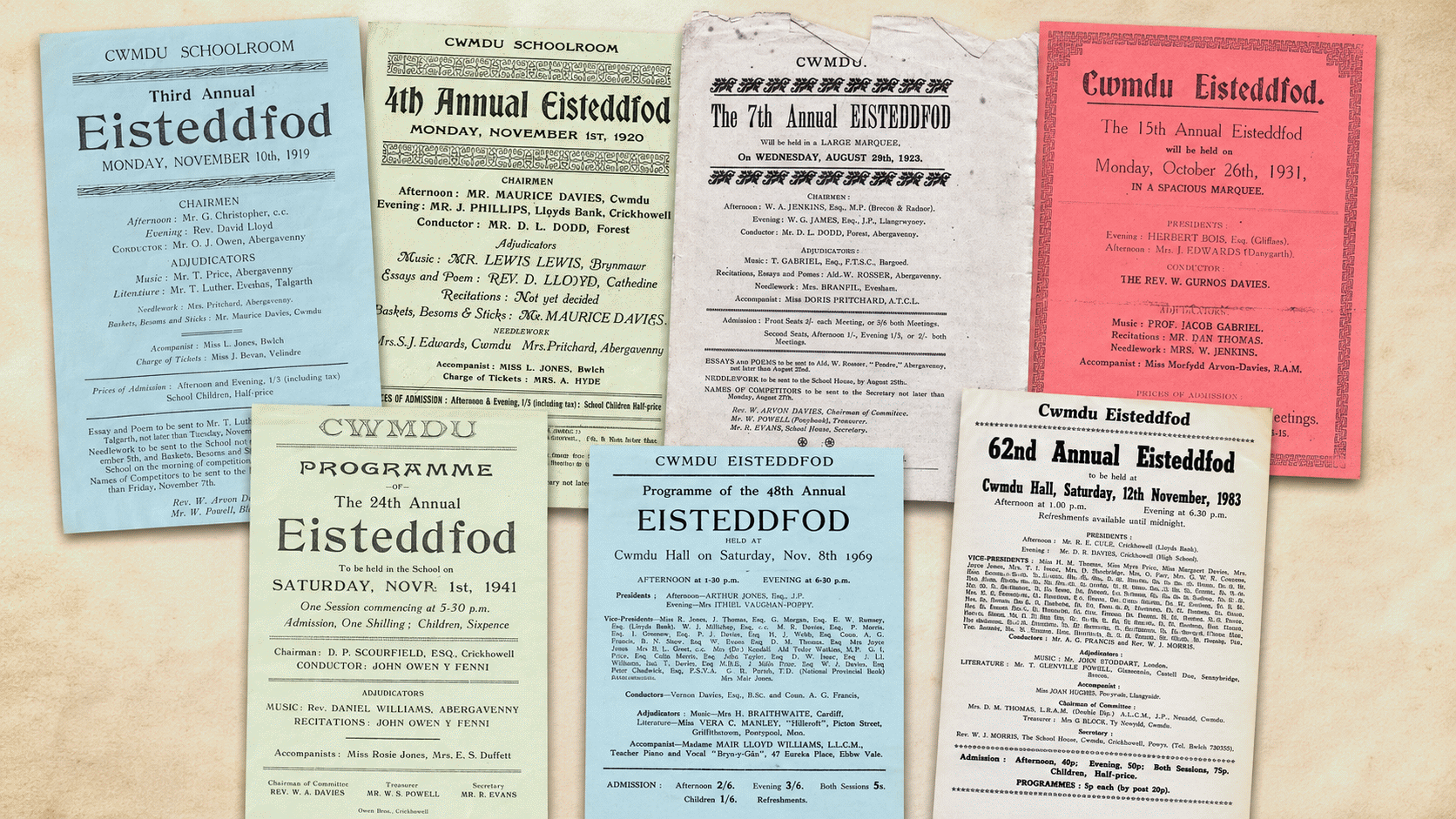
It’s interesting to note that the first Cwmdu Eisteddfod was convened in 1916. One wonders whether the original intent may have been to lift the spirits of local people, amidst the ugliness and suffering of the First World War, and to bring people together. Certainly, it would have brough huge comfort to loved ones at home, to read a silly Limrick or clever sentence composed by a distant son, brother or father, possibly in some unseen, horrible trench or campaign. One hopes such distractions and connections might have been comforting to these soldiers too.
The numbering in some of the programmes seems a little confused, but we believe that the Cwmdu has not held an Eisteddfod only twice, since it was set up. Once during the first World War and again during WWII. War is the enemy of creativity. More history regarding the (very nearly!) Annual Cwmdu Eisteddfod
|